Friday, October 23, 2020

Election 2020 - Last Presidential Debate

The final Presidential Debate of 2020 has happened.  In fact, it is very likely the final electoral debate we'll see both Donald Trump and Joe Biden have in their lives.  Compared to the first debate, this debate had a much more civil tone.  However, in my myopic opinion, this debate will have a much more defining impact in this race. Why?  Because there are multiple defining moments that I think voters will remember from this debate.  So let's go through them, shall we?

Coronavirus - If it was not for the Coronavirus, I think Trump would be headed to a typical comfortable Presidential re-election,  especially after his electoral standing actually improved after his Impeachment (a la President Bill Clinton). But the Coronavirus has cast great doubt from many on Trump's ability to lead through crisis.  Hence, Trump has always been reactionary regarding criticism of his leadership here and it has cast a dark cloud on his Presidency.  However, in my view Trump had the strongest defense of his leadership on Coronavirus.  Trump recognized the seriousness of the issue, talking about the progress being made in finding vaccine/therapeutics, protecting vulnerable populations and expressing optimism of getting the pandemic behind us.  Biden, as expected, blamed Trump for the unfortunate malaise that has resulted the pandemic, saying that it's time to change leaders with someone with a real plan instead of a naive cheerleader like Trump.  Trump was able to fight off the charges to what believe a draw by saying that Biden's plan is basically his plan, that Biden is doing Monday morning quarterbacking regarding initial reaction to the virus and illuminating Biden's failed leadership fighting the H1Ni swine flu.  He also brought up the economic and social damage lockdowns have brought to NY. Biden, in a rebuttal I think he regrets, cited NY as a model on how to address the virus.  Trump, seeing this teed up opportunity, brings up that NY has highest number of Covid-19 deaths in the nation.  

However, the following was the defining statements of this section of the debate:


In short, Biden is advocating a cautious, reactionary strategy against the virus.  A strategy that advocates to restrain behavior.  That would be a strategy where the government dictates liberties in one's behavior based on "expert" opinion.   Trump, on the other hand, is advocating a more risky, aggressive strategy against the virus.  A strategy to develop a 'new normal' in the way we live as they find ways to attack the virus.  It is clear nowadays that there is a growing number of individuals experiencing "Covid fatigue" and want pandemic live to just be over.  They want  a life where they can gather together, work (the opportunity to work) and travel freely and be able to have solid life structure with their kids in school without being excoriated by their government.  I think Trump's defense and strategy here may actually stemmed the bleeding he had on this issue.

Race - Trump had, by far, the best defense of his record on racial relations by emphasizing his accomplishments to help open up opportunities for blacks while demonstrating that Biden has actually closed opportunities for blacks.  By talking about his accomplishments in criminal justice reform, minority economic opportunity, investment in Historically Black Colleges and Universities (HBCUs) Trump clearly demonstrated he has more tangible affirmative accomplishments in the advancement of minority opportunity than any President in multiple decades.  Additionally, he emphasized Biden's only major accomplishment that affected race relations, criminal justice reform in 1994, actually put more young blacks in jail due to its harsh penalties on minor drug offenses.  Biden did not a a strong rebuttal on this point, only vaguely saying he tried to reform the drug offense penalties.  He was more interested in attacking Trump's personality and attitude regarding race, saying he "pours gasoline" on racial dialogue. However, I think the fact Biden called Abe Lincoln a "the most racist President in modern history" referring to Donald's comparison to Abe Lincoln showed he really had no substantive answer on how he would try to improve racial relations outside of having a more meek personality.  In short, this section showed a great contrast between Trump, a man attempting and accomplishing moves for positive action, against  Biden, who can only criticize but doesn't really have answers himself.
 
Hunter Biden's emails - Actually one of the most memorable moments of this debate happened before the debate.  Just like in 2016, Trump hosted a guest that cast doubt on the character of his opponent.  This time that guest was Tony Bobulinski, a former business associate of Hunter Biden.  Bobulinski testifies that the Hunter Biden's emails regarding questionable business activities with a Chinese company are authentic, plus he has more first-hand evidence himself to provide that supports the idea that the Biden family participated in multiple illegal schemes. At the debate, Trump pressed Biden about these emails.  Biden says he did nothing unethical and eventually went on to say the whole charge is based on "Russian disinformation."  This is an odd defense to make an hour after someone directly alleged they were real and they have the receipts to prove it.  How much this hurts Biden remains to be seen, but it could be easily seen how this hurts Biden's "better character" argument by raising his unfavorables.

Insider vs. Outsider - One of the most memorable moments of the whole debate was when Trump drew the contrast between him and Biden in regards to getting things done.  The video in the tweet below demonstrates that contrast.

As a viewer, I immediately saw how Trump succinctly made a successful argument that Biden was a politician that gives many promises, but has delivered few results. This happened after about hour of Trump touting his accomplishments in a number of areas. A very shrewd move by Trump that was highly effective.

Body Language - In the first debate, Trump went very aggressive in both his approach, constantly interrupting Biden when he was trying to answer.  While such an approach may have been effective in some ways, many came away thinking Trump just cannot control himself from imposing his strong personality to intimidate his opponents.  

Hence, in this debate, Trump took a much more mellow approach.  He was much more respectful in both engaging in his dialogue as well as his body language when listening to Biden's responses.  Occasionally he would give that a look of disapproval, but it was a vast contrast from the first debate.  I thought that was quite effective because it demonstrated that Trump can in fact control his emotions and personality to act more "Presidential."  

Biden, however, acted quite the opposite.  When he disagreed with something, his reactions were very visible.  When he was defensive, he had that "deer in the headlights" look or visible disgust (oh G*d).  However, it was clear Trump was wearing out Biden throughout the debate after I saw this:


The last Presidential candidate that looked at his watch during the debate was President George HW Bush (Bush 41).  Let's just say that election didn't end well for him.

Fracking - No issue has hurt Biden more than fracking.  Biden, who like his running mate, Kamala Harris, said during the primary that he would eradicate fossil fuels and fracking.  Has during the general election stated he wouldn't ban fracking.  With that in mind, the following clip has put some doubt in the sincerity of that pledge.

Pennsylvania, Ohio, Texas.... I think many voters in those states saw him say that.  I'll just leave it there.

So in the end, I think Trump didn't hurt himself through this debate and perhaps helped himself by demonstrating memorable contrasts with Biden.  However, we will see how much, if any, effect this debate has on the final outcome.  If we know anything, a week is a long time in politics.

In my next blog, I will provide a guide of what I'll be looking for during Election Night as well as where my electoral map is currently.  Until then, it is what it is....

Saturday, October 17, 2020

Election 2020: Lightning Striking Twice?

 So we are about two weeks away from the election and closer we get to it the more things seem like 2016.  I was told we'd never have an election like that one.  But again, who predicted we'd have 2020 like we have either.  

Think about the last couple weeks:

  • About a month before the 2016 election, Donald Trump gets blindsided by the "Access Hollywood" videotape where he jokingly explains sexual assault to Billy Bush.  Trump's polls tank and it looks like Hillary Clinton is about to cruise to a 350+ electoral vote victory.  Now think about 2 weeks ago where Trump contracts Covid-19, the communication of his condition as he works through it is a bit opaque and inconsistent and he comes out of it looking like he's bragging that he recovered quickly and folks should not worry about Covid-19.  This negative news cycle causes the national polls to tank in favor of Joe Biden, who about 10 days ago looked to be heading to a 400 EV victory.  However, one thing was consistent between those two situations.  Trump, who looked to be down and out, starts to show great discipline and tenacity in the consistency of his message as well as the vast increase in the number of rallies. Both times also the rallies were both very large and showed high energy.
  • About two weeks before the 2016 election, Clinton was blindsided by the revelation that an inquiry was opened regarding new emails connecting her to alleged felonious activity that showed up on former Rep. Anthony Weiner's laptop that was seized by the FBI as part of a sexting scandal Weiner was being investigated.  This created great uproar from Donald's supporters and enthused his base, as well as further raise Clinton's already high unfavorables. In this past week, again about two weeks before the 2020 election, we have learned that Biden's son, Hunter, has a laptop now sent into the FBI that included emails connecting alleged felonious business dealings where Hunter leverage access to Joe with businessmen in Ukraine, Russia and China.  The additional twist here is that after the NY Post broke the story, Twitter and Facebook were quite aggressive in censoring its distribution, including suspending the Twitter account of the White House Press Secretary.  As with Clinton, this news has further enthused Donald's supporters as well as probably raised Biden's unfavorables, which are at a lower level than Hillary's were at this relative part of the election cycle.  
So the question is whether the large momentum swing that these events resulted in 2016 to lead to a Trump victory can be replicated in 2020.  While we wait to see what happens, I will break it down this way: there are two main elements to Trump's campaign strategy. 

  • Maximize the enthusiasm of his base.  It was clear in 2016 he was able to do that as his supporters drowned out Clinton's on Election Day 2016.  He was able to motivate new voters, specifically white-working class voters and evangelicals to unite provide him votes with impressive unity. I am seeing signs of that in 2020 with the size and energy of his rallies as well as the Amy Coney Barrett SCOTUS nomination as key drivers to that enthusiasm.  One advantage that Trump does have in 2020 than 2016 is since the party registration numbers in key battleground states are much more favorable to him (read more about that from last week's post), he has a larger poll of potential voters and more possible votes to gain.
  • Maximize his opponent's unfavorables. In 2016, Trump focused a large part of his campaign on increasing Clinton's unfavorables by trying to define her as a corrupt political grifter (remember "Crooked Hillary"). The Weiner laptop incident only poured more gasoline into those efforts and they largely worked.  Evidence of that is the increase in working class voters that don't have significant college and graduate education as well as the lack of enthusiasm in Clinton's base, especially amongst Black voters.  Together, this depressed Clinton's votes in urban centers like Detroit that allowed Trump to eek out slim margins in winning states such as MI, PA and WI.  The issues Joe Biden is starting to have with his base are starting to reveal themselves, as he's trying to hold events that will enthuse the votes in urban centers like Detroit and Miami.  We'll see where this story goes.

I've made a couple notable changes on the map:


As you can see, I moved New Hampshire back to Biden and Michigan to Trump, which would allow him to be re-elected.  The New Hampshire change is just a fleeting hunch as that state is hard to read.  However, I haven't seen Trump appear to make any visits there in recent weeks or talk about his chances there.  So I'm wondering if it's a place of focus currently.

Michigan, in my opinion, is starting to trend more strongly towards Donald.  Early voting figures there are very good for Donald and Biden's decision to break his protocol against larger campaign events to do a "voter motivation" event in Detroit as well as do interviews with Detroit radio stations provides some evidence than Biden is quite worried there.  In addition, Michigan has a strong GOP Senate candidate, John James, that should help pour more outside money to support the GOP, aka Trump's, side.  So I am feeling that Trump is strongly trending positive there.

Next week, I'll provide a review of the final debate (if it happens) as well as a preview of what keys I'm watching for on Election Night.  But until next time, it is what it is.


Saturday, October 10, 2020

Election 2020: What About Those Polls?

We are about three weeks from Election Day and when I thought 2016 was a unique election, 2020 is a chaotic one.  Every week we have a new headline.  Over the past month, the news cycles has gone from President Trump accused of vituperating against dead soldiers, not paying his fair share of taxes, to being in Walter Reed hospital with Covid-19.    Now we're seeing Trump recovering quickly from Covid-19 with the help of experimental medication, but the next debate canceled.  These are interesting times.

Quickly, I still don't have any changes in how I see the electoral map in terms of electoral votes, but I've become more solid on FL as a state becoming safer for Trump.


I just want to make some comments about the public polling we're seeing currently in this race.  Since Trump's Covid-19 diagnosis as well as his public reactions to it, including a SUV ride to wave at supporters while still at Walter Reed, his public poll numbers have plummeted nationally.  Here are some of the changes we've seen:

  • NBC\Wall Street Journal: Biden +8 Sep to Biden +14 Oct;
  • Fox News: Biden +5 Sept to Biden +10 Oct;
  • CNN: Biden +8 Sept to Biden +16 Oct;
On the face of it, it looks like the bottom is falling out on Trump's support.  In fact, at these spreads, Biden would probably be well on his way to 400 electoral votes.  However, while I can see that Trump's support has taken a hit over the past week through the combination of a negative news cycle of Trump catching Covid-19, his Administration botched communication surrounding it and that Covid-19 is Trump's weakest issue, I remain skeptical the change is that large.   There are several reasons I am skeptical.

  • There are several polls that have not seen much of a change at all:
    • The Hill/HarrisX: Biden +7 to Biden +5
    • Economist/YouGov: Biden +8 to Biden +9
    • IBD/TIPP: Biden +6 to Biden +3
  • Additionally, the RealClearPolitics average in battleground states (PA/MI/WI/FL/NC/etc) Trump is running 0.5% ahead where he was in 2016.
  • If Biden is so far ahead nationally, why is he still traveling to these battleground states and not typically safer GOP states such as Texas and Georgia?
  •  In quite a few of these polls, they ask the question who they think will win the election/who their neighbors are voting for.  The results are quite striking:
    • Fox News Oct: Trump 48%/Biden 39%
    • Economist/YouGov: Biden 40%/Trump 37% (23% unsure)
    • Gallup: Trump 56%/ Biden 40%
  • Finally, one way to actually measure enthusiasm and trend with real data is to measure voter registration for states that register by party.  Voter registration by party shows the pool of available voters that a candidate should have to turn out (bigger pool=more available votes). Looking at several battleground states, The results are again quite revealing:
    • North Carolina (Trump win 2016): 2016: Dems had 646K advantage/ 2020: Dems hold 400K advantage
    • Florida (Trump win 2016): 2016 Dems had 330K advantage/2020: Dems hold 136K advantage
    • Pennsylvania (Trump win 2016): 2016 Dems had 936K advantage/ 2020: Dems hold 717K advantage.
In summary, while national polls feed a media narrative of a widening Biden lead, voter sentiment of their thoughts of the race, voter registrations and battleground state polling suggest a very competitive race. 

Why would this be the case?  My thought is that the the polls have a wide variance because the methods they use and the distribution of respondents the pollsters receive from those methods.  
  • Most polls use live callers as the way to receive responses.  They call folks and if the respondent agrees, have them answer 60+ questions.  While this method was fine 10-15 years ago when smartphone use wasn't as widespread, it is a relatively high cost for the respondent now.  Folks that are most likely to affirmatively participate in such polls generally pay higher attention to politics than the normal person, have time on his/her hands to answer all those questions and/or have adverse incentives to participate (i.e. paid survey taker).   
  • Also, in an age where telemarketers are face great skepticism from respondents regarding the respondents privacy, it's not unreasonable to think that the responses would be what they think is the most socially acceptable, not what they really think.  For example, how socially acceptable was it in June to call Black Lives Matter a Marxist group?  Following the news not very acceptable.  Respondents therefore may tell the pollsters they approve. Hence, the poll responses are more of a reflection of what the respondent thinks the pollster wants to hear, not what they really think.  
  • Live caller as the sole method also is very biased towards more white collar tilt in their distribution, which would tend to be more urban.  While a 30-ish old professional who keeps on top of the news is motivated to complete the survey, someone like my mother, who has no college education and works long hours, does not think too much of talking to a cold caller for 40 minutes on the phone.  Your truly has marked these cold calls as "Potential Spam" on my phone. Hence, a class bias is generally not accounted for in live caller polls.  
  • In my professional life, I worked as a consultant that had to collect individual opinions on specific topics.  To gain those opinions, I used multiple methods of calls/emails/text to gain survey responses.  One way to address the respondent distribution and social intimation biases is to give respondents multiple options to respond with a shorter survey.  Reducing the cost of completing the poll survey will lead to a more inclusive respondent pool and more likely one that accurately reflects the electorate.
So there you have it, my thoughts on how to read the polls these days.  Just like in my professional life, I'm going to look at multiple metrics to assess this race, not just the polls.

Until next time, it is what it is. 

Thursday, October 1, 2020

Election 2020: First Debate Reaction

 Well, I guess we can say that like it or not, the first 2020 Presidential Debate between Trump and Biden actually did happen.  So if you're not bored or disgusted by commentary of last night's debate, here's a few myopic observations:

  • It didn't take long for this debate to fall off conventional script.  Chris Wallace, a journalist that I respect, made it known at question 2 that folks had to fit into their two minute boxes, When it was clear that Wallace was particularly forceful in trying to enforce that rule on Trump after Biden made a point, it was clear that Trump changed strategies on the fly and decided to use Wallace as a conduit to it.  Through creating adversarial interactions with Wallace, Trump got to control the situation and feeding his base's (as well as a notable amount of the general public) strong skepticism of the media.  It made me think that Trump wants to continue to enthuse his base by showing he's a bully that's fighting against the mainstream media and the Swamp in general.
  • Trump and Biden's dialogue was anything but civil.  It was clear after Trump changed tactics that he wanted to force the strength of his presence and personality on Biden to manipulate Biden to lose his temper and make mistakes.  Biden, to avoid that, tried to avoid eye contact with Trump through much of the beginning of the debate.  But after the tenor of the dialogue turned into a food fight, Biden glanced over more often, but more to mock than engage.  
  • How effective were Trump's tactics?  I think it was mixed bag.  
    • Biden's temper did start to flare up multiple times as he called Trump as 'racist', 'clown' and said 'man' more often as the debate went on as the debate became more petty.  If one came into this debate thinking Biden was the more decent man with a better disposition to be President, I would think such actions would bring doubt to that assertion.  
    • However, in pressing so hard, Trump missed several big opportunities to actually create distinctions with Biden and extol his accomplishments.  For example, on the race question, Trump went right to law and order and the economy, but not to his historic funding of Historically Black Colleges and Universities (HBCU); or the fact that while he commuted Alice Johnson's sentence for drug trafficking, Biden was a lead sponsor of the law that sentenced her to lifetime imprisonment.  Trump was pressing so hard that while he said 'sure' on the question on denouncing White Supremacists, it was not a very clear response.
    • Another consequence in Trump's pressing so hard is that we really didn't get to feel the effect of Biden's answers.  For example, Trump asked Biden about a police union that has publicly endorsed him as Trump brags about the number of police unions endorsing him.  As Biden muttered weakly, Trump goes ahead continues to press.  If Trump just was silent for 10 more seconds, it would have exposed the effect that Biden couldn't think of a police union endorsement he received.  This happened multiple times on issues regarding Hunter Biden, packing the Supreme Court, law enforcement, etc.  If Trump had a few more pregnant pauses, he probably could have exposed more of Biden's lack of conviction in his positions.
  • So why did Trump pursue such tactics? There are several reasons, but three in particular.  
    • One, as my first point stated, it was to enthuse his base by using Wallace as his foil.  A key to Trump strategy is to maximize his base's enthusiasm.  One main tenant of Trump's strategy is to maximize enthusiasm so they will go out to vote.   The 'us against the establishment' game has worked quite well for Trump in that aspect and using Wallace as that establishment was very convenient.
    • Two, Trump wants to raise Biden's unfavorability.  This is the another main tenet of Trump strategy.  In 2016, Trump was successfully able to raise Hillary Clinton's favorability to levels close if not higher than Trump's. So far he hasn't really been successful in raising Biden's favorability largely because Biden has largely been out in the public while spending large sums of money on ads presenting a positive image of him.  In the debate, Trump wanted to rattle Biden so Biden would lose his composure and make mistakes.  In that area, Trump was largely successful as stated above, Biden did call Trump names, as well as the worst president in US history (James Buchanan, anyone?).  By calling Trump names as well as showing obvious irritation, Biden's attempt to show himself as a return to decency in terms of temperament took a real hit. In addition, in doing that Biden also showed his age in his feeble retorts compared to Trump's strong personality. 
    • Three, while Trump wants to enthuse his base, he also wanted to depress enthusiasm in Biden's base.  In regards to this goal, Trump had some success.  He got Biden to say he's not for defunding the police (accusing Trump of doing so), wouldn't say if he'd pack the Supreme Court and stated he wasn't for the Green New Deal (where his staff needed to correct he was for afterwards).  These types of statements won't really fire up the liberals in his party, especially those under 30 who have spent much of the year either flooding the streets or supporting those flooding the streets for various social causes.  In fact, it'll leave them more skeptical of Biden's authenticity and depress their enthusiasm.  Like him or not, Trump generally comes off as authentic, which makes it easier for him to create enthusiasm.  Biden still has a gap to fill to show voters he's authentic enough for their vote. Changing positions on the fly does not help there.
  •  One last item I do want to address is the optics of Trump's pressing of Biden.  
    • The general feeling I get from many folks and the news is that it shows that Trump just can't help himself from being a bully and it's quite untoward for a President to act that way.  Well, I can see their point.  However, most of the folks that I hear that are either/or college educated, white collar, and/or suburban in their background.  I don't think Trump was going after their vote, especially since they are a shrinking portion of the "swingable" electorate.  The appeal to suburban voters apparently went away with current Senator Mitt Romney, who won independents by still got crushed in his Presidential run. Trump's strongman tactics appeal to working-class and rural voters, which has more support from than the normal GOPer. 
    • While currently much of Trump's base is White, Hispanics and Blacks (especially males) can relate to Trump's tactics, which is how Trump can expand his base.  Folks, just as much as working class folks like my father could relate to Trump's word salads,  Hispanics and Blacks in large part can relate to the multiple interruptions and bullying tactics of Trump's style in the debate.   In many a movie with Hispanics or Blacks featured in it as well as conversations I've heard on the street, their tone of debate/argument often goes the same way Trump pressed on his the debate.  They don't go into the argument trying to listen for two minute before a rebuttal.  They will inject when they see error and try to bury their debate opponent until their either get them to surrender or look very weak.  Strength and force is treasured in such conflicts and I don't find it odd when a Spanish-speaking Telemundo poll says nearly 2/3 of their voters say Trump won the debate, largely because they can relate to him and his tactics.
I will pass on a electoral map this week since I want to see the effects of this debate for a couple more days before coming to conclusions.  But don't worry, I will present one quite soon.

Until next time, it is what it is.

Friday, September 25, 2020

Election 2020: Small Things Make a Big Difference

So we're in the final week of September and I currently don't see any change in the electoral map from last week.

As it can be seen, there's a ways to go in this election.  Based on this map, MN would be an arguable tipping point state in this election.  Based on my analysis last week in MN, I could really see Trump being the first GOPer to win MN since 1972.  I argued that if he could do better with working-class, non-college graduates, especially in NE MN (i.e. Duluth and the Iron Range) he could do so. This theme applying to other battleground states (OH,WI, MN, PA) would have a similar effect.   So I was quite pleased to see that the Cook political report provided a "Swing-O-Meter" to do some sensitivity analysis on how demographic changes in the electorate changes the election outcome.

For example, currently the default map on the Swing-O-Meter is this


But now let's assume the following:

Trump's share of white, non-college grads goes from 69% in the above map to 70% and their turnout goes from 55% to 57%.  Here's the effect:


A pretty marginal change can make a large difference, one that is quite plausible from my myopic opinion.  Now let's look the at if instead of the above scenario if Trump share of white, non-college grads goes down to 67% and Biden's lead amongst white, college grads goes from 54% to 55%


There's been much buzz in anecdotal stories that Trump is doing better with Blacks and Hispanics than 2016.  So to test if that really makes much of a difference, let's hold all the shares of the electorate and the White/Asian vote shares splits the same as the default scenario.  I then change Trump's vote share of Blacks from 8% to 11% and his Hispanic share from 28% to 33%.


I guess it would make a significant difference.  So as I said at the beginning, there's much to see yet for the rest of this election.  Small changes in the electorate will make notable differences.

Talking about notable differences, the first debate is this upcoming week.  While there are many who think that Biden's public appearances would portend to Trump easily winning the debate, I beg to differ.  Incumbent Presidents generally haven't done well in their first debates, especially over the last 40 years.  Outside of President Bill Clinton showing much more vigor than Bob Dole in 1996, the incumbents haven't done well.  

  • President Reagan's performance had voters wondering if he was becoming senile.  
  • President George HW Bush looked at his watch during the debate, not something you want to publicly communicate how you feel in front of the electorate.    
  • President George W Bush looked quite tired, repeating the same line ("He (John Kerry) always changes positions").  
  • President Obama looked quite out of sorts from Mitt Romney's attacks on Obamacare.   
Each debate notably boosted the challenger in the polls.  Now in all the situations outside of President George HW Bush, the incumbent President was able to recover in following debates to win re-election.  However, beware of the expectations.

So until next time, it is what it is.

Saturday, September 19, 2020

Election 2020: An Ongoing Episode

As we pass mid-September, things are changing.  Kids are getting back to school in one form or another.  The leaves are changing color.  Football is actually being played across the country.  

But for many folks, the events that are gaining interest are the events affecting the 2020 election.   I've heard from folks the 2016 election was the strangest they ever experienced.  I'm wondering if a good number of them are thinking 2020 is even stranger than that with the impeachment, yet failed expulsion, of President Trump.  A COVID-19 pandemic which had effects not seen since the 1918 Spanish flu.  The pandemic caused politicians to shut down their local economies and has created distrust with public health officials and large segments of the public on how to protect public health.  I frankly never thought we'd think wearing a mask is a political issue, but it certainly is.  Now the latest news is whether or not to replace the late Justice Ruth Bader Ginsburg's vacancy on SCOTUS.  2020 certainly has not been a boring year.

Hence, I've decided to provide some of my perspective on this year's election as well as a map of where I think the presidential election between President Trump and Joe Biden currently stands.  I'll attempt to provide these posts weekly and I would appreciate your comments (just keep them civil).   

Here's my current map of where the Presidential race stands.


In other words, this is a very close race at the moment.  The election will largely be won in the battleground states (MN, WI, PA, AZ).  Here's where I think each state's race is at the moment.

AZ: Much polling has shown Biden with an edge in this state.  However, I think the issue with much public polling is the way they are sampling voters.  Many surveys polls are either by cell or online panel.  That's a poll that looks straightforward to take if one is a professional who has some level of college/postgraduate education.  However for folks like my parents, who didn't go to college and really don't like using a computer outside of work purposes, are less likely to volunteer to complete a survey online or questions on a phone call because it's not a good use of time in his/her opinion.  The thing that 2016 proved is the latter is where Trump has his strongest support: working-class folks without a bachelors or postgraduate degree.  In AZ, as in much polling, I think too few of those folks took those polls to give an accurate picture, especially in Maricopa county, the state's largest county population wise.  My feeling is that Trump is up by 1-2 points there, but it's quite close.

WI: Biden is shown to have slight to moderate leads here.  However, while I think he's currently slightly ahead there, it's probably currently 2-3 points.  This gap can be closed by Trump doing better in the Milwaukee suburbs (with Kenosha, recall what happened there) and maxes out in Northern WI north of Madison and Milwaukee.  

PA:  Biden is shown to have slight to moderate leads here as well.  However, while I think he's currently slightly ahead there, it's probably currently 2-3 points.  This gap can be closed by Trump doing better in the Philly suburbs (notably Bucks County) and maxes out in Western PA.  If Trump wins Bucks County, Biden better do better than Hillary did in 2016 or he probably loses PA without any corruption.  I don't suspect there will be any notable shady behavior, but in 2020 we've seen the unexpected more than once.

MN: Biden has shown to have lead here as well.  But I think the polls are underestimating Trump's strength outside of the Twin Cities Metro.  In 2016, Trump lost St Louis county, where my hometown Duluth is the county seat, by 14 points, yet lost the state by 44K votes.  That means Trump did much stronger in the rest of the outstate than the normal GOPer.  That's the truth (he won the 8th Congressional district, which includes Duluth, by 18 points, the 7th district (Western MN), by 30 points and the 1st district (Southern MN) by 15 points.  Regarding St Louis county, 7 Iron Range Democratic (DFL) mayors have come out in support of Trump due to his work on opening up mining in the area and his trade policies towards China.  I also think Trump is more natural cultural fit to folks in the Iron Range by the way he communicates and emphasis on culture wars (abortion, antiwar, etc).   So I wouldn't be surprised if Trump expands his margins in the 8th district.  And by my travels lately through the 7th district recently, Trump will probably have at least 30 percent margins in the 7th.  Biden needs to rely on strength in the Twin Cities Metro and in Rochester/Duluth to pull him over the line.  Currently I think Biden is leading by 1-2 points, but it's going to probably depend on Get Out To Vote (GOTV) on who wins here.

Till next time, it is what it is....


Monday, May 11, 2020

Florida and Georgia Trip Observations

Last week, I went to Jacksonville, Florida for some business travel.  I made a few observations from my trip:

-  The airlines are really hurting.  On both plane rides on my roundtrip to and from Florida, each passenger had their own row.  Everyone had to wear a mask on the plane.  It was actually a somewhat depressing sight.

- The terminals are pretty empty.


- In Florida, life seems to be much more active than in Minnesota.  Many folks are outside walking around.  While it was the first week of Phase 1 of Gov. DeSantis's re-opening plan, fast food restaurants were still strictly drive-thru and delivery.  I did see some restaurants have some outdoor seating, but it was lightly attended late afternoon.

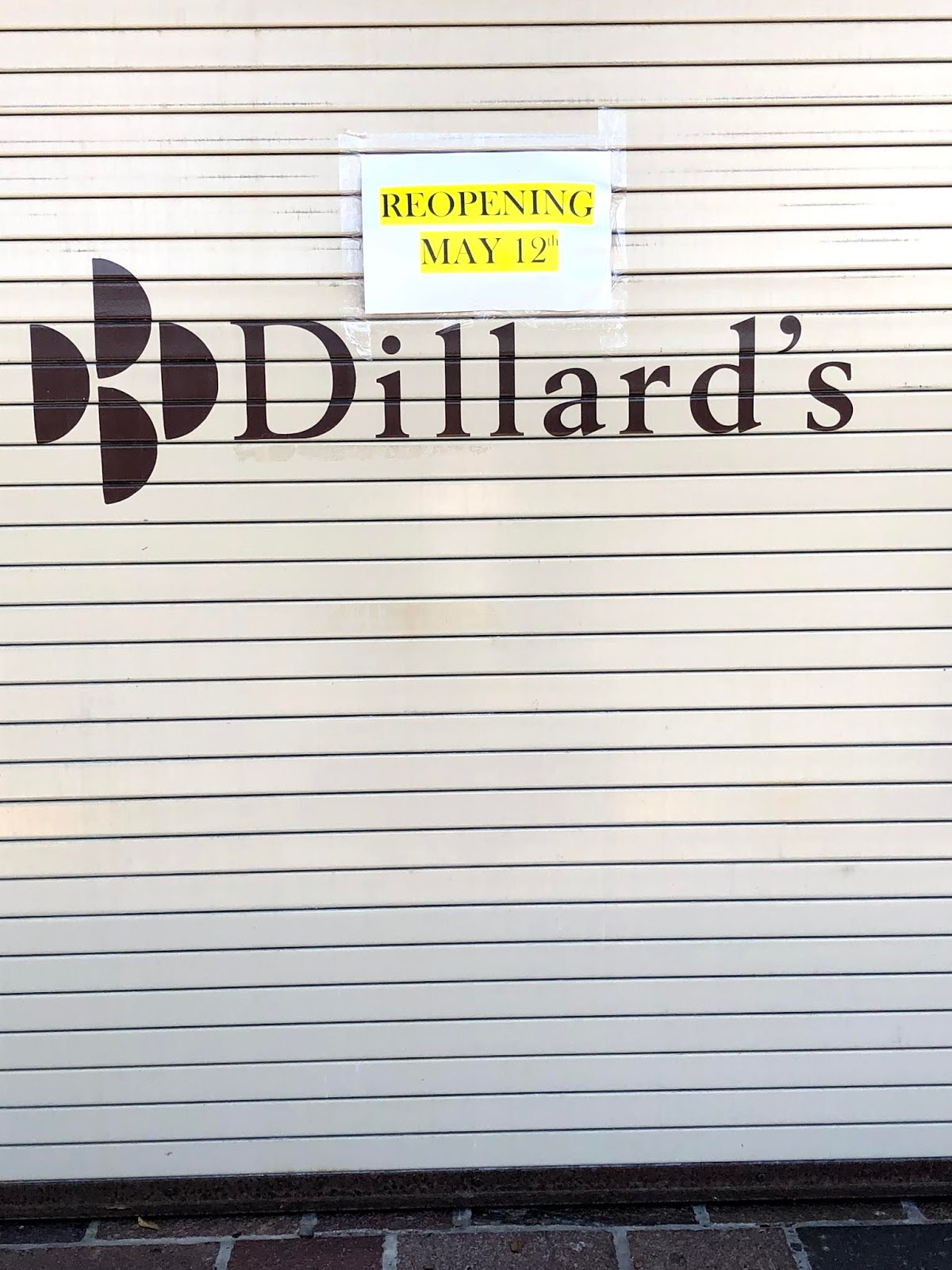
- I did walk through St. John's Town Center, the large outdoor mall in Jacksonville though and see that while stores could start opening, store operators were cautious.


- Since Jacksonville is about an hour from the GA border, I decided to make a run for the border and get a haircut.


The barber who greeted me at the door asked me a couple questions about how I was feeling and took my temperature.  I gratefully passed and was led down this marked path to a sink to wash my hands.


While the lady was cutting my hair, I learned a few things:

 - The barbers are all part of the same family: husband, wife and children all cut hair.
 - They all wore masks when cutting hair.
 - They didn't receive any help from the government or any financial institution.
 - It was really a no brainer for them to re-open, even though they received many complaints that they shouldn't from others in town.  They really wanted to have the ability to gain their lives back.
 - She really appreciate that the family had the choice to re-open.  I said that folks had the choice to come or not.  I also said that many folks don't take into account what steps the barbers are trying to take to protect their reputation.  She appreciated the support.

So in all it was an enlightening trip.  Life is coming back to different parts of this country.  Once citizens have the ball in their court to make decisions, the question of confidence in the decisions will ultimately dictate how quickly life will return to the expected normal.